
Orthodontics
For people who don’t have a keen interest in reading or research, the term is obviously unfamiliar. There are actually twelve letters forming the word, but as much as the First Five Oral Health team is concerned, it can bring you a lot of knowledge regarding dentofacial orthopedics. It’s a branch of dentistry concerned with the diagnosis, prevention, and correction of malpositioned teeth and jaws.
Now, does that make a lot of sense already? Better be yes because, at First Five Oral Health, one of our main concerns is the patient’s emotion while looking at the mirror and discovers that his or her set of teeth are far apart, making him look like more than an orangutan than a human. Needless to say, but we all have our own sets of imperfections. There is no need to be embarrassed about your condition; therefore, please give our dental team the chance to transform and correct your teeth with the following services below:
Malocclusion treatment
It is a dental condition where there is a misalignment or incorrect relation between the teeth of the two dental arches when they approach each other as the jaws close. There are three distinct treatments including an extensive or series of tooth extraction, and the other two are as follows:
- Clear aligners – these are devices that are transparent, a plastic form of dental braces used to adjust the teeth.
- Dental braces – these are orthodontic devices known as braces or cases that aligns and straightens teeth and help position them with regards to a person’s bite, while also aiming to improve dental health.
Fixed appliances
This orthodontic procedure is only applicable when treatment involves moving teeth through three axis planes in the mouth. These movements would include:
- A rotation where the teeth are not conforming to the arch shape, and there are contact displacements
- Multiple tooth movements where there may be crowding involved, and the correction would involve the movement of numerous teeth in differing planes.
- A bodily movement may be required to move a map-aligned tooth into the arch where the broad, long axis of the tooth is correct but the tooth needs moving back into the arch maintaining the axial positions.
- Tipping or changing the incline of the long axis of the tooth where the tooth may be proclined or retroclined, and the tooth angulation is altered.
- Root torquing – where the angle of the long axis of the tooth is changed with the position of the root being altered to facilitate a more naturally positioned crown and root prominence.
Types of fixed appliances
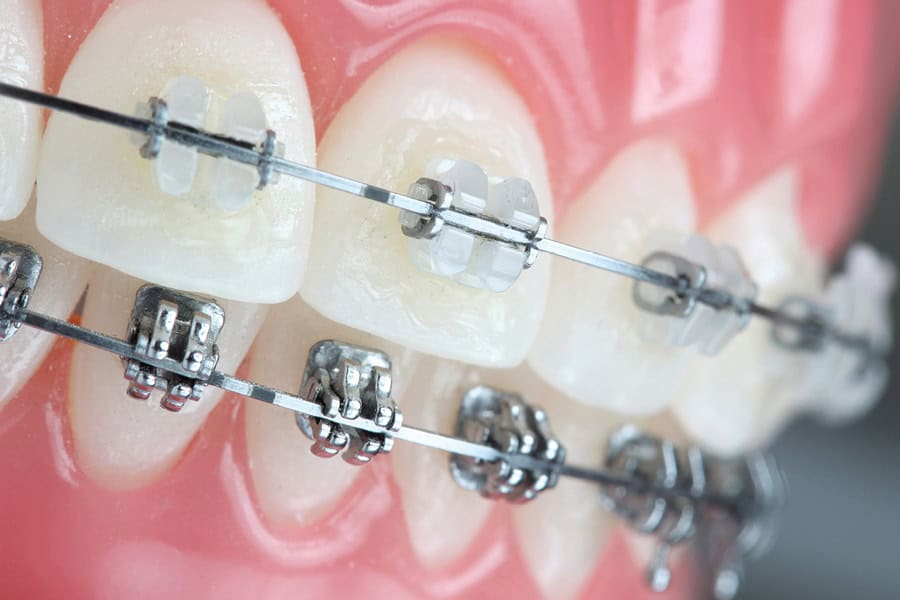
- Brackets
The main parts of a bracket are:
- Wire slot
- Bracket base – can be used to spot weld onto orthodontic bands
- Tie wings
- Orientation marker – placed on the disto-gingival aspect of the tooth
- Archwires
Archwires are made from differing metal alloys and are supplied as either straight lengths or as preformed archwires. There are different types of archwires including:
- Light to heavy
- Round / rectangular
- Braided or multi-strand
Archwires are carefully fitted into each bracket slot ready for ligation. Ligating is done using either elastic modules or thin wire ligatures: ‘Quick Ties.’ The closer the fit of the archwires in the slot on the bracket, the greater the control of the teeth. As treatment progresses, thicker wires are used to fully control the teeth in three dimensions.